


A friend of mine said something to me recently that made me pause. We were catching up, and I was telling her about a few things I had changed in my routine lately, and she said she wished she had my willpower.
I understood what she meant, and it was a kind thing to say, and it was also not true. I use almost no willpower to run my life. Not because I am unusually disciplined, but because years ago I stopped trying to force things into the wrong parts of my day and started paying attention to where they actually fit. That distinction is worth a lot more than discipline, and it is available to you starting this week.
1. Willpower is a resource with a bottom.
One definition of willpower I came across calls it exerted control to get something done, and that word ‘exerted’ is the whole story. It is force. You are pushing something uphill because you decided it needed to go uphill.
You can do that. You can do it Monday, and Tuesday, and probably Wednesday. Somewhere around day nine or day fourteen, the tank hits empty, the thing stops happening, and you land right back where you started with a new piece of evidence that you cannot stick with anything. That is not what happened. What happened is you ran a system on a fuel source that was always going to run out.
2. Check the belief before you check your discipline.
Before you look at your calendar, look at whether you actually believe the thing will work.
If you are starting to lift weights because you want to feel stronger, you have to believe on some real level that lifting weights will make you stronger. When that belief is missing, no amount of determination will carry it, because you are asking willpower to do the job that conviction is supposed to do. Any time I notice I am forcing something and it is not getting easier, that is the first place I look. Sometimes the honest answer is that I never bought into the action in the first place, and the fix is not more effort; it is picking a different action.
3. Treat the first attempt as information.
The first time you do something new, it will probably take some real push, and that is fine. Willpower is a decent tool for getting a thing started. It is a terrible tool for keeping it going.
So use that first go-round to gather data. Notice what specifically felt hard. Notice what time of day it was, what you had just finished doing, how much was already stacked around it. You are looking for whether it stayed consecutively hard, because hard on day one is normal and hard on day one through day six is the system telling you something.
4. Move the activity, not yourself.
This is where it all lives.
When I write, actual creative writing, sitting down to do it at two in the afternoon takes every bit of willpower I have. Every part of me is kicking and screaming. If I put that exact same task at nine in the morning, I might still groan a little because it is not my favorite kind of work, but I get into it, and it gets done, and it costs me almost nothing. Same task. Same me. Different pocket of time.
Exercise works the same way, and this is the one where people get the most convinced they are broken. Some women cannot make themselves exercise in the morning, and some women know that if it does not happen in the morning it is never happening. Neither one of those women is doing it wrong. I am firmly in the second camp, and knowing that about myself has saved me years of forcing.
So think of your week as a puzzle instead of a schedule. Move the piece and see what happens. If a task takes less push at seven in the morning than it does at four in the afternoon, you have just found free energy, and you did not have to become a more disciplined person to get it.
One swap to try this week
Pick one task you have been dragging yourself through. Write down what time of day you have been attempting it, and rate how much push it took to start, on a scale of one to ten.
Then move it. Put it in a completely different pocket of time, at least a few hours away from where it has been living, and do it there three times this week. Same task, same rating, same scale. Write the number down each time.
If the numbers drop, keep it there and stop thinking about it. If they do not, move it again next week and run it a third time. Two or three rounds of this is usually all it takes to find the spot where something stops fighting you.

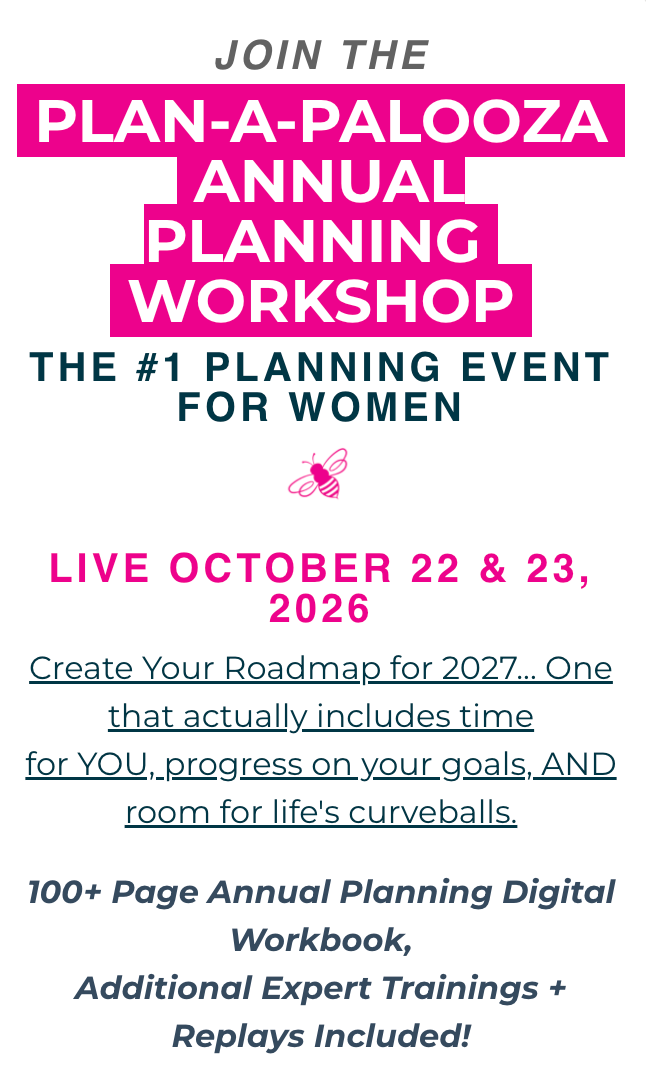
- Plan-a-Palooza 2026 — Grab Your Ticket Before Early Bird Ends ✨

Plan-a-Palooza is coming up, and it's my favorite two days of the whole year. It's the one live event where I teach my full annual planning method from start to finish, and we build your Year at a Glance and Annual One-Pager together in real time.
Early bird pricing is only available through August 31, so this is the best time all year to grab your seat before it goes up. You don't need any special planner or experience going in; just come with your calendar and whatever you already use to track your life, and we'll build the rest together. I'd love for you to join me live on October 22 and 23.

Annual Planning: The 4 Levels of Planning Series (Part 1 of 4)
I'm kicking off a four-part series on the four levels of planning that actually run your year, and we're starting with the big one, your annual plan.
If you've ever built a goal list in January that felt exciting for about a week and then quietly disappeared, this one's for you. Goal setting and annual planning are not the same thing, and most of us only ever do the first. I'm walking through what separates a real annual plan from a glorified wish list, the three pieces that make a plan actually work instead of just sound good, and when to build yours so it's not a last-minute scramble.
This is just part one, so if you've been curious about the bigger system behind how I plan my whole year, start here.
|


How many projects are too many to have going at once?
If you've got a handful of projects going at the same time and nothing seems to be moving forward, I've got a simple tool that will show you exactly why.
It's one of the foundational pieces we build together in Plan-a-Palooza, and once you see it laid out for your own year, you'll immediately spot the month where you're stretched way too thin. There's a number where things really start to break down, and I bet it's lower than you think.
Remember, this video is updated every Wednesday, so don’t miss it! Head to The Pink Bee app to watch now.

Friend, don’t forget, just 15 minutes of planning today can set the tone for your entire week. You’ve got the tools, you’ve got the tips, and now it’s time to take action. Let’s crush this week together!





Responses