

Every time a new year rolls around, my inbox fills up with messages from women sending me pictures of planners, asking "Should I get this one?" or "Will this help me finally get organized?"
And I get it. You're scrolling through social media seeing ads for every organizational tool under the sun, all promising they'll be THE solution that finally makes everything click in 2026.
I'm going to break down exactly which planning tools you actually need (spoiler: it's either two or three, depending on your life stage), what purpose each one serves, and how to choose the ones that will actually support you.
1. Get crystal clear on what your planner actually needs to do
Your planner has one job: tell you what you're doing and when you're doing it.
This is the tool that lives in the weeds of your life, where your weekly and monthly planning happens. It's your reference point to make sure you're not getting overbooked within the confines of a week or a month.
Now, people get tripped up when they buy something marketed as a "life planner" that tries to be everything: goal tracker, habit builder, gratitude journal, meal planner, and calendar all smooshed together. This becomes overwhelming instead of helpful.
Your planner should keep it simple. What you're doing and when you're doing it.
You've got to choose between paper or digital first. I'm a paper planner person (no surprise there), and I use the TOP Planner as my command center. But if you want to go fully digital, I recommend Artful Agenda because it actually lets you do full monthly planning in ways other digital tools don't.
2. Add a family communication center if you're coordinating with others
If you're single and managing just your own schedule, skip this one.
But if you live with other people (a partner, kids, aging parents you're helping), you need a household communication center where everyone in your home can see what's going on, who's in charge of what, and when things are happening.
The magic? You stop being the one everyone asks a million times a day: "What's for dinner?" "Who's driving me?" "What's happening this weekend?"
I personally love the Skylight Calendar for this. Yes, there's some overlap with what goes on my personal planner versus the family communication center, but my planner manages my time while the family calendar empowers everyone else and keeps us coordinated.
3. Create a system for your longer-term planning
This is the tool everyone forgets about, and it makes the biggest difference.
You need something that lets you see and plan the big picture stuff: long-term projects, quarterly goals, that 10-day spring break, the work trip in April, the major report due in three months.
Traditional calendars (paper or digital) don't work for this because you can't get the right visibility. Try pulling up a yearly view in Google Calendar and all you see is a bunch of tiny boxes with days in them. You can't actually see the information you need to plan strategically.
This is where I do my quarterly and annual planning, and honestly, it's the secret to how I keep growing the business while staying on top of everything at home and working on personal goals.
I use gorgeous wall calendars from Kaleidoscope Living because I can see all 12 months at once and block out time for projects, protect busy seasons, and plan around life's bigger rhythms.
Ready to get your 2026 tools in place?
You can keep buying planners, hoping one will magically fix everything, or you can stop the cycle right now.
Pick your planner (paper or digital). Decide if you need a family communication center. Get something in place for your bigger-picture planning.
Then commit to actually using them.
Because the right tools plus the right system equals finally feeling like you're in control of your time instead of your time controlling you. And trust me, that feeling is worth way more than another planner sitting in your closet unused.

- Ditch the Overwhelm Podcast!
I created this limited series podcast to help you gain control over your schedule in a way that helps you thrive. It doesn't matter how many things are on your plate daily; there are ways to prioritize your schedule so it doesn't overwhelm and stress you out.
Productivity isn't about getting all the things done. It's about prioritizing the important things and knowing what you're capable of doing. If you're tired of feeling behind and want practical strategies that actually work with your real life, this podcast is for you. Let's ditch the overwhelm together.

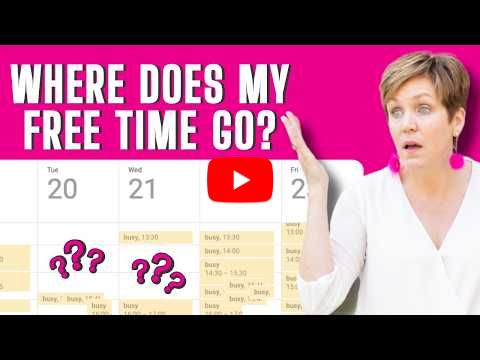
Why You Never Get to Use Your Free Time + How to Fix It
You block off white space in your calendar, those open gaps where you're supposed to have breathing room. Space just for you to take a break, read a book, or literally do nothing. But day after day, you run around like crazy and never actually get to use that time for yourself. The white space you carefully planned just disappears.
In this video, I'm breaking down what white space actually means, the three things silently consuming every minute of white space you leave in your calendar, and how to properly plan for buffer time, uncertainty, and personal appointments so you finally get true white space that actually works for you.
|

How to Manage Your Workload When You Don't Control What Gets Piled On Your Plate
If you're working a job where you don't have complete control over your workload, with a boss who loves meetings and keeps assigning new projects without realizing you're already maxed out, this is for you.
In this week's Weekly Buzz, I'm sharing the tool I used frequently in the corporate world to manage overwhelming workloads without looking like I wasn't a team player. You'll learn how to have a data-driven conversation with your boss that removes the emotion and actually gets results, what information to gather before that conversation, and how to frame it in a way that puts them back in the driver's seat of fixing the problem instead of you just drowning in tasks.
Remember, this video is updated every Wednesday, so don’t miss it! Head to The Pink Bee app to watch now.

Friend, don’t forget—just 15 minutes of planning today can set the tone for your entire week. You’ve got the tools, you’ve got the tips, and now it’s time to take action. Let’s crush this week together!







Responses